
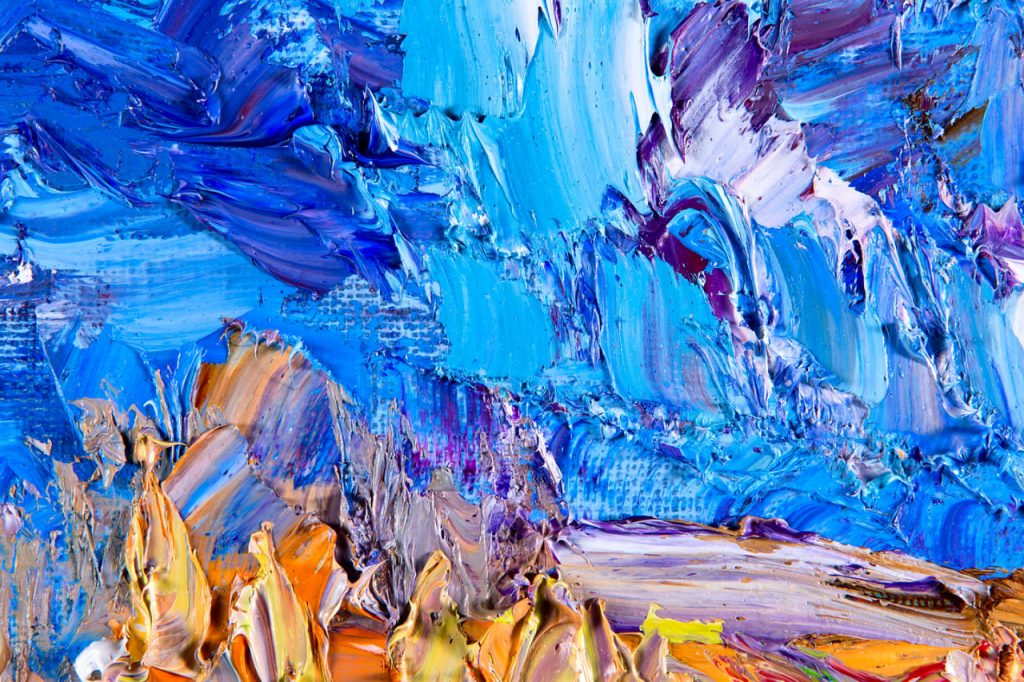
When painting landscapes in oils, it is easy to get caught up in the countless colors of foliage and details of the scene. Yet, without proper rendering of light and shadow, even a perfectly rendered landscape will appear dull, or two dimensional. Light and shadow are the tools used to give the subject three dimensions, to guide the viewer’s eye, to communicate atmosphere and mood, and to add life to the landscape.
That’s not to say that you can’t capture light with oil paint – in fact, it has some properties that make it ideal for depicting light and shadows. The slow-drying properties of oil paint, its high pigment load, and the ability to use both glazes and impastos allow for a greater range of possibilities when building three-dimensional forms and suggesting complex shifts of value. But all of those factors also make it more important to handle your composition, your colors, and your techniques just right in order to prevent muddying the image or creating an unconvincing illusion.
There’s another major component that is often overlooked in landscapes: light. Light can be a really cool thing, but it can also be very tricky to work with. Light can’t be seen, which means it can’t be viewed as a colored object, but it is something we can’t live without.
Lighting is everything in landscapes. It affects the color palette, value structure, and atmosphere of a piece. Attention to light direction, light type, and light value is essential to capturing natural subjects effectively.
Light from a cloudy day is softer and more diffuse. With soft light, the differences in values from the light side to the dark side are not as dramatic. When the day is bright and sunny, the light is stronger and the shadows sharper. Shadows are dark and highlights are light. There is greater contrast between the light and dark sides of the forms. Knowing these differences can help you decide how to draw a scene and what colors to use and where to place the emphasis in your scene.
Grasping the relationships between values is crucial.
Another important element to consider is value, the lightness or darkness of a color. For example, in a landscape, the hills or mountains in the distance will typically be lighter in value than those in the foreground, which will appear darker and more detailed.
When you have a clear order of values, it helps keep your work from being flat and provides a path for the eye to move around the painting. I encourage you to exercise your ability to see and order values by reducing a detailed landscape scene into three areas of value—light, medium, and dark—then balancing those areas for contrast, which makes the painting easier to read.
Using a Shadow to Model Form:
Shadows describe the forms of landscape elements. Trees, rocks, hills, buildings—without shadow none of them exist in three dimensions. Study the shadow form, the shadow angle, and the shadow color. Shadows are almost never black or gray. They receive the light around them and the colors around them.
Blending oil paint shadows with their environment also makes them more acceptable. If necessary you can glaze over the shadow area to darken or cool it. The softness of shadows can also vary. Soft edged shadows are found under overcast conditions or when the object is in shade. Hard edged shadows are found when the object is in direct sunlight.
Another way to communicate how a light is coming across is by describing its color temperature. This is a bit more technical, but the idea is that different lighting conditions have distinct color characteristics that can be used to paint a picture in the listener’s mind.
Color temperature plays a huge role in visual perception. Warm colors (yellows, oranges, warm browns) come forward and generally represent light. Cool colors (blues, purples, cool greens) recede and represent shade or distance.
The temperature of a color can also be used to create a sense of depth, to model form, and to suggest the effects of the atmosphere. A hill in sunlight, for instance, might be painted in warm yellow and ochre hues, while a hill in shadow might be painted in cool grays and browns.
When it comes to photographing light, it is the appearance of the light that we are concerned with—not its color. Therefore, we want to record as much information about the light as possible to ensure that it will look good when the image is printed.
The general effect of a landscape is its lighting. For example, a warm, golden light (as during the early morning or late afternoon hours) will result in a cozy effect. A cool, midday light will bring out more detail. Note, for example, how the color of the sky is often mirrored in the reflection off the surface of a body of water; how the light shining through the leaves of a tree will create dappled shadows on the ground below; how the roughness of tree bark or rock will affect the resulting shadows.
While oil painting is mostly used for color and value transitions through glazing, blending, and layering, slight changes can be indicated with the weight of brushstrokes and thickness of paint to show the range of light and dark.
Key Takeaways and Insights
Highlights are essential for communicating light. In an oil painting, highlights are usually achieved with heavier paint or higher in value in order to draw the viewer’s attention. They work best when used minimally and in areas that would naturally reflect light, such as the surface of water, wet rocks, or leaves in sunlight.
Reflections add to the depth and realism. It’s important to depict the color and value of the reflected light to portray water, a wet road, or a piece of glass. In an oil painting, it’s common to blend or feather reflections to avoid disrupting the overall forms.